THE STORY
Two legends. One play at the plate.
Ted Williams & Yogi Berra · September 21, 1951
Ted Williams and Yogi Berra stood on opposite sides of one of baseball’s defining rivalries.
Williams was already one of the greatest hitters the game had seen—a fiercely disciplined student of hitting whose career would become synonymous with Boston. Berra was emerging as the heart of a Yankees dynasty, a catcher whose unconventional appearance belied extraordinary instincts, athleticism and an ability to see a play developing before almost anyone else.
On September 21, 1951, those two careers converged at home plate.
Williams came toward home. Berra received the throw and launched himself across the plate to make the tag. In the photograph that preserved the moment, he remains suspended above the ground as Williams slides beneath him.
The play lasted only seconds.
The photograph made it permanent.

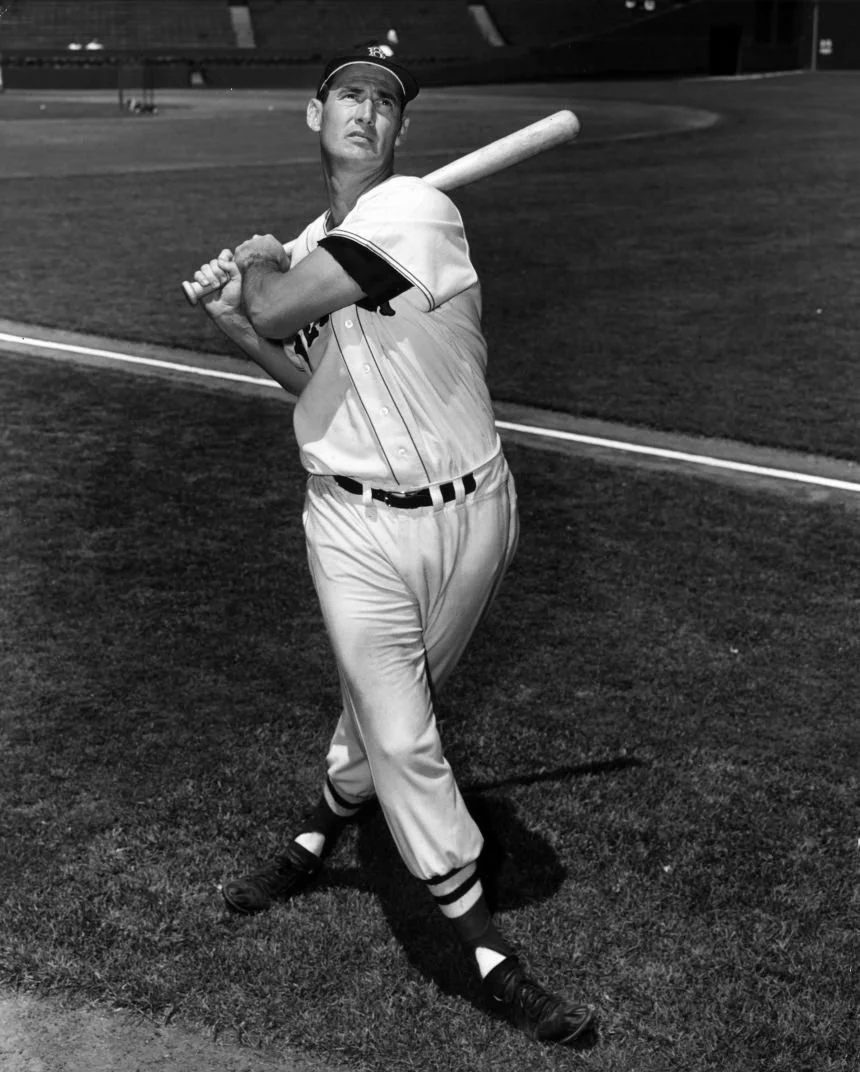
TED WILLIAMS
The swing became an obsession.
Ted Williams approached hitting not simply as a natural gift, but as a craft that could be studied, measured and eventually mastered.
He arrived in Boston in 1939 at 20 years old and almost immediately became one of the most dangerous hitters in baseball. Two years later, he batted .406—the last major-league player to finish a season above .400.
But Williams’ career cannot be understood only through the numbers he accumulated.
He studied pitchers, strike zones and the mechanics of his swing with extraordinary intensity. He believed a hitter should understand exactly which pitches he could drive and have the discipline to wait for them. That philosophy eventually became the foundation of The Science of Hitting, the book in which Williams distilled what he had spent a career refining.
His career was also interrupted twice by military service. Williams served as a Marine Corps aviator during World War II and was recalled to active duty during the Korean War, costing him nearly five full seasons during what otherwise would have been the heart of his playing career.
Still, across 19 major-league seasons, he hit .344 with 521 home runs, won six American League batting titles and twice captured the Triple Crown.
Williams wanted to become the greatest hitter who ever lived. He built his life around the pursuit.
YOGI BERRA
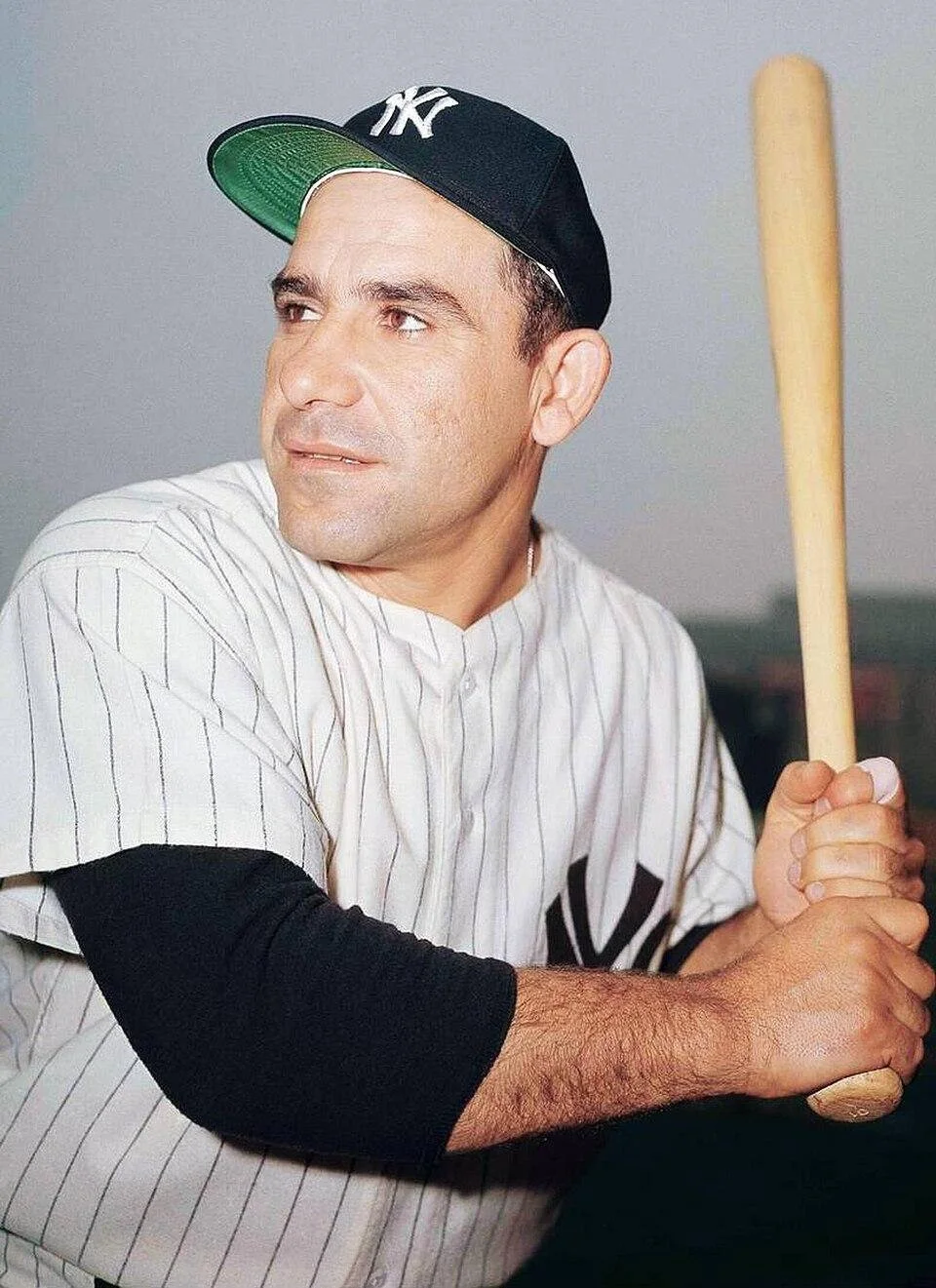
He seemed to see the game one step ahead.
Yogi Berra did not look like the prototype of a great major-league athlete. At 5-foot-7, with a compact build and an unconventional style at the plate, he hardly resembled the image of a superstar.
Then he started playing.
Berra joined the Yankees late in 1946 and became their primary catcher as one of baseball’s greatest dynasties took shape. Behind the plate, he developed a reputation for understanding hitters, handling pitchers and anticipating what might happen next. At bat, his remarkable ability to make contact allowed him to drive pitches almost anywhere they were thrown.
The results were extraordinary.
Over 18 seasons with the Yankees, Berra was selected to 18 All-Star Games, won three American League MVP Awards and hit 358 home runs. More remarkably, he played on 10 World Series championship teams—more than any player in major-league history.
But statistics only partly explain his importance to those Yankees teams.
Berra played catcher at the center of everything. He called pitches, controlled the running game, watched the positioning of fielders and constantly processed what was happening around him.
That awareness would become particularly visible in one photograph from 1951.
THE RIVALRY
By 1951, Boston and New York needed little introduction.
The rivalry between the Red Sox and Yankees had been building for decades, but the era of Williams and Berra gave it some of its defining characters.
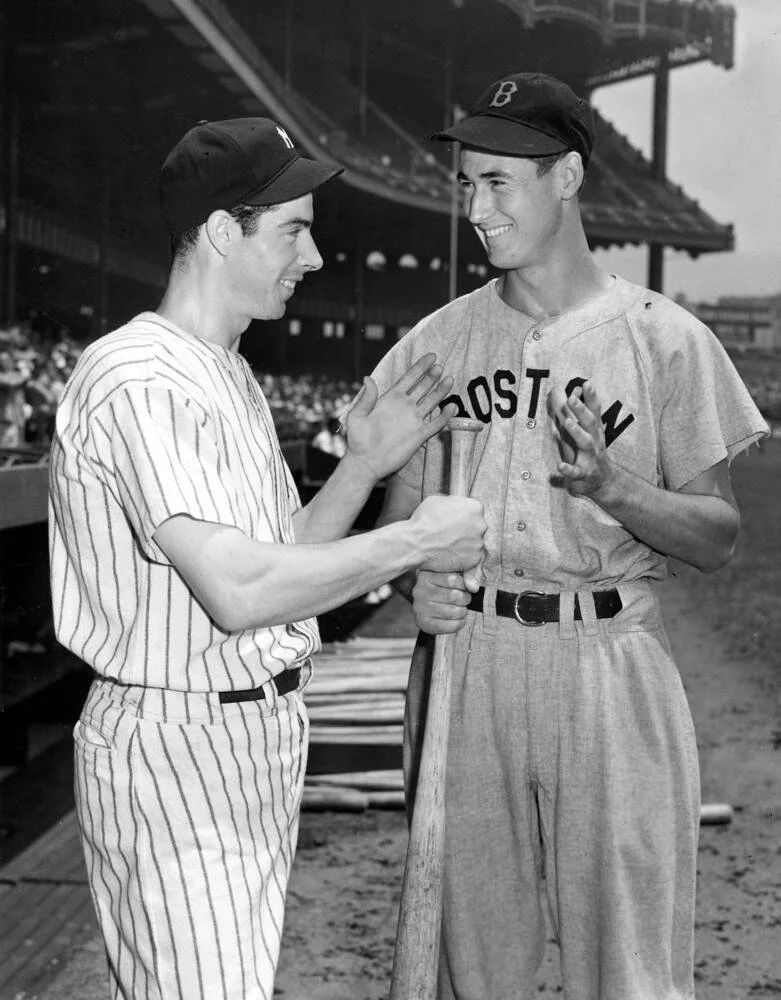
Boston had Ted Williams. New York had a succession of stars that included Joe DiMaggio and, increasingly, Yogi Berra. The teams met again and again over the course of a long American League season, their histories intertwined by geography, competition and the shadow of Babe Ruth’s move from Boston to New York a generation earlier.
For Williams, Yankee Stadium became an unusually important stage. The Yankees repeatedly stood between Boston and the postseason, turning games in New York into some of the most consequential of his career.
The rivalry reached a remarkable peak in 1949.
Boston entered the final two games of the season at Yankee Stadium needing only one victory to win the American League pennant. New York won both. The Yankees took the pennant by a single game and went on to win the World Series.
Two years later, the balance had shifted even further.
By September 1951, the Yankees were pursuing their third consecutive World Series championship. Berra was in the middle of an MVP season and would soon win the first of his three American League MVP Awards.
Williams remained one of baseball’s most feared hitters.
On September 21, their teams met again at Fenway Park.
And this time, the rivalry would be captured in a single frame.
SEPTEMBER 21, 1951
The Yankees were closing in. Boston was running out of time.
By late September, New York was again in control of the American League race.
The Yankees entered September 21 in first place, pursuing a third consecutive pennant. Boston remained mathematically alive, but the Red Sox were fading from contention as the season approached its final days.
At Fenway Park that afternoon, the teams opened a three-game series.
For much of the game, the score remained close. New York carried a narrow lead into the later innings before pulling away for a 5–1 victory.
But somewhere within those nine innings came a play that had little effect on the championship race and no obvious reason to outlive the game itself.
Ted Williams had singled, and when Clyde Vollmer doubled, Williams tried to score all the way from first.
Yogi Berra was waiting at home.
The throw arrived. Williams went into his slide. Berra moved across the plate and applied the tag.
Williams was out.
Then the shutter clicked.
THE PHOTOGRAPH
The remarkable part is where Berra is looking.
At first glance, the photograph is about collision and movement.
Williams is sliding through the dirt toward home. Berra is stretched horizontally above him, his body suspended in the air. Their uniforms, limbs and movement seem to converge for a fraction of a second before separating again.
But look at Berra’s face.
He isn’t watching Williams.
The tag is already complete, and Berra’s attention has shifted back toward the field. Years later, when discussing the photograph, his granddaughter Lindsay Berra would point to this detail: even while still airborne, Yogi was already looking toward second base to see whether another play was developing.
It is a small detail, but one that reveals something larger about the player.
Berra’s reputation was built partly on that kind of awareness—the ability to process the game beyond the immediate play in front of him. Here, that instinct is visible.
Williams is still completing one play.
Berra has already moved mentally to the next.
The camera caught both moments at once.
THE LEGENDS
The photograph grew more remarkable with time.
In 1951, Ted Williams and Yogi Berra were already among the most recognizable players in baseball.
Neither had finished building his legacy.
Williams would soon be recalled to military service, fly combat missions in Korea and return to baseball to continue hitting at an extraordinary level well into his forties. When his career ended in 1960, he had compiled a .344 batting average, 521 home runs and a .482 on-base percentage—still the highest in major-league history.
He was elected to the National Baseball Hall of Fame in 1966.
Berra’s greatest years were still unfolding. He would win three American League MVP Awards, appear in 14 World Series as a player and win 10 World Series championships with the Yankees—a total no other player has matched.
He entered the Hall of Fame in 1972.
Their names eventually became inseparable from the franchises they represented: Williams from Boston, Berra from New York.
That is part of what gives the photograph its power today.
It did not capture a ceremonial meeting between two retired icons. It caught them in the middle of an ordinary baseball game, still building the careers that would eventually make them legends.
For one fraction of a second, those two careers collided at home plate.
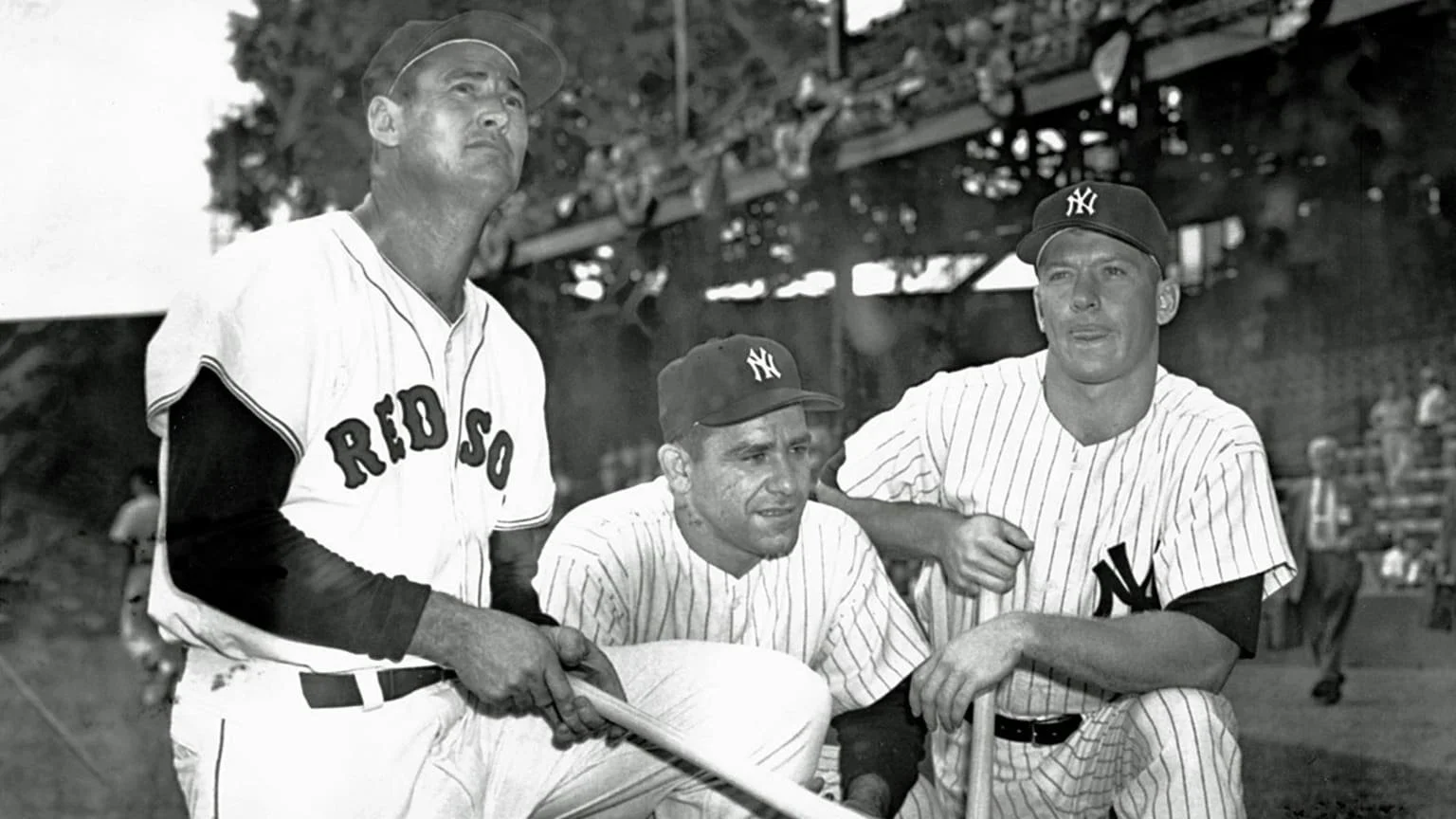
Ted Williams, Yogi Berra and Mickey Mantle.
THE PAINTING
The moment already contained everything the painting needed.
The photograph that became Legendary immediately stood apart to me.
There was the collision itself—Ted Williams sliding through the dirt as Yogi Berra stretched across him—but what interested me most was the contrast within the image. Williams is grounded in the dirt, carried by the momentum of his slide. Berra seems almost suspended above him, his body moving in one direction while his attention has already shifted elsewhere.
I wanted the painting to preserve that tension without simply reproducing the photograph.
The square composition brings the two figures tightly together, removing much of the surrounding field and concentrating the image around the collision at home plate. The limited palette—Indian Yellow, Transparent Red Iron Oxide, Dioxazine Purple and Titanium White—pushes the work further away from a literal historical photograph, while layers of transparent color, exposed marks and texture keep the surface itself active.
At 20 × 20 inches, Legendary is more intimate in scale than many works in the collection. That smaller format makes the moment feel concentrated rather than diminished—the viewer is brought closer to the figures and to the fraction of a second the original photograph preserved.
The title came naturally.
Williams and Berra would become two of the defining figures of their generation. But in this image, none of that history is ceremonial or distant.
They are simply two ballplayers, meeting at home plate.
The careers became legendary. The moment came first.
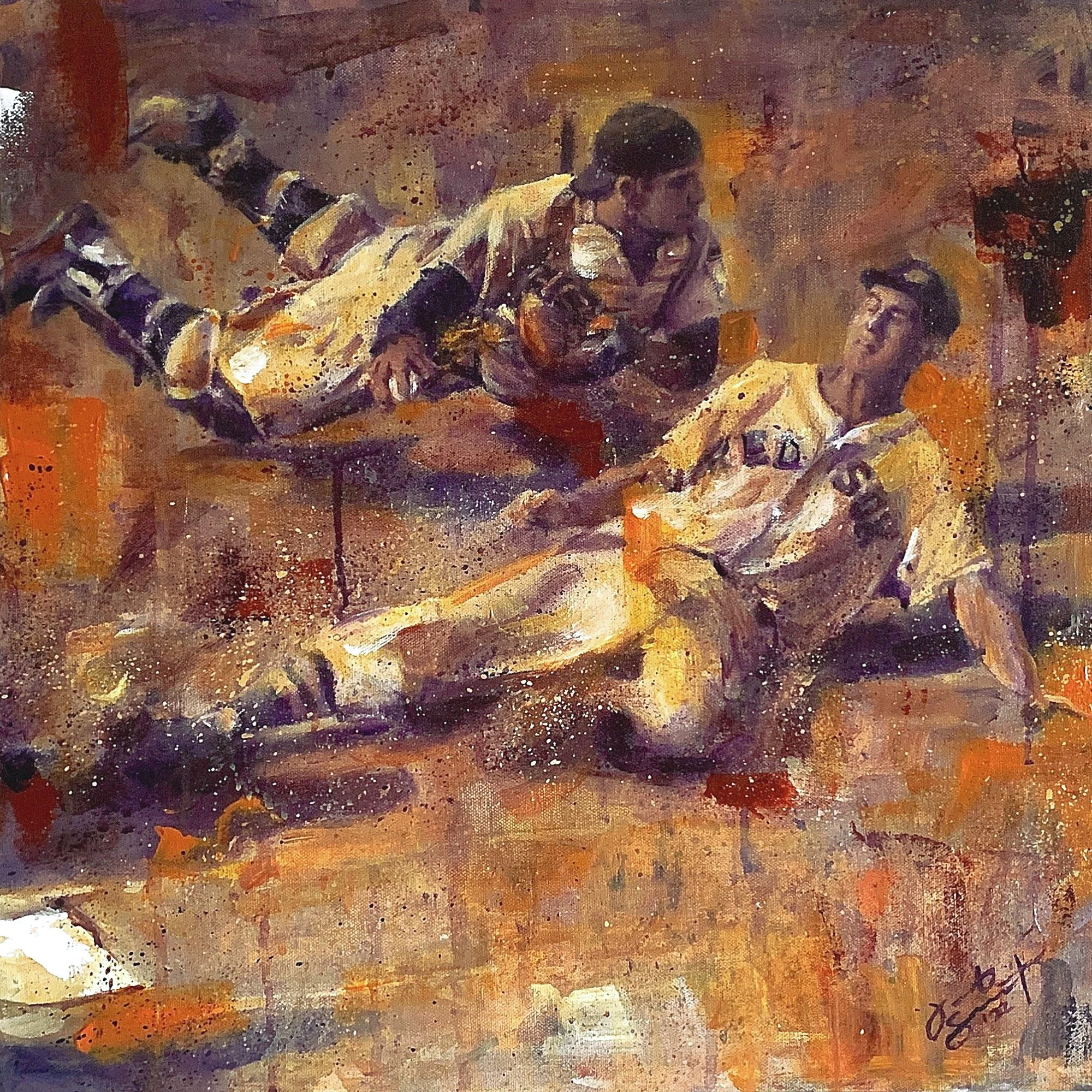
Legendary
20 × 20 in. · acrylic on heavyweight gallery-wrapped canvas